



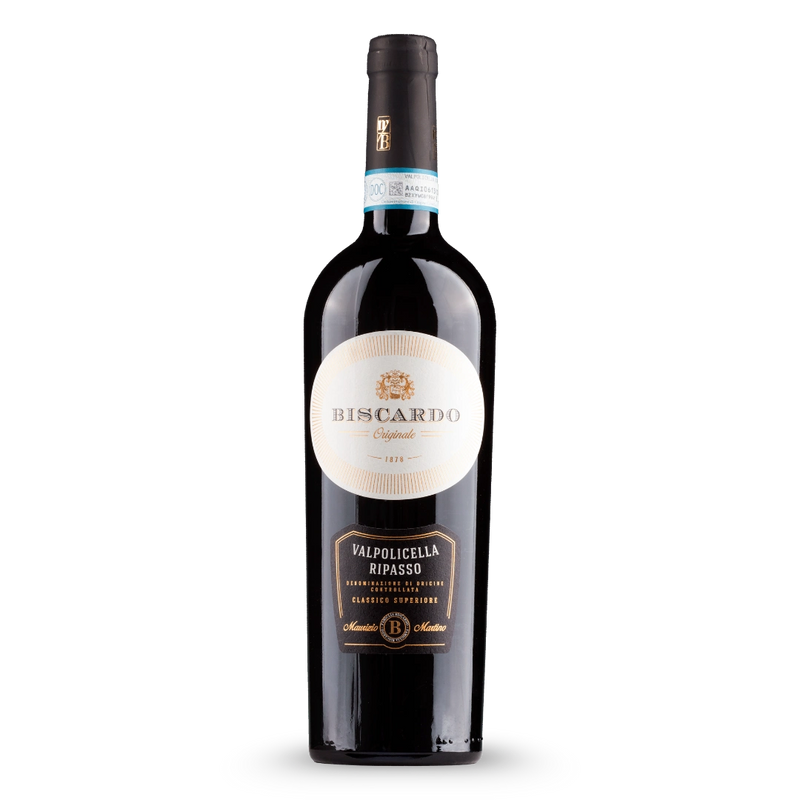


The grapes grow on sites at altitudes of 150-250 meters in the heart of the beautiful Veneto region. The chalky soils are well-ventilated and provide the vines with nutrients. Like Amarone, Valpolicella Ripasso is made from three different grape varieties: Corvina, Molinara, and Rondinella, which are classic Valpolicella varieties. Harvesting is carried out entirely by hand, with winemakers paying particular attention to the time of day, harvesting only at sunrise and sunset to avoid the hot sun. Workers place the grapes in small wooden crates, protecting them by not crowding them too tightly. This keeps the grapes for Biscardo Valpolicella Ripasso intact until they arrive at the winery.
In the winery, processing takes place as quickly as possible. After a light pressing, Martino begins fermentation. The young and fresh Valpolicella is then aged in stainless steel until early next year. In early February, the special "Ripasso method" follows. Grape skins, which were removed during the production of Amarone, are "pulled" through the already finished Biscardo Valpolicella Ripasso. This is how the winemakers achieve a kind of "second fermentation." The wine becomes denser, more concentrated, and juicier. The bouquet also develops a much greater variety. Finally, the wine is aged for at least twelve months in oak barrels and for a short time in barriques.
The Valpolicella Ripasso shines in the glass with a ruby-red to garnet color. The bouquet offers aromas of jammy cherries, blackberries, and mocha, followed by chocolate and almonds. The palate is very full and smooth, yet it has a good tannic structure. This perfectly conveys its power and elegance. Finally, it has a long and juicy finish.


