
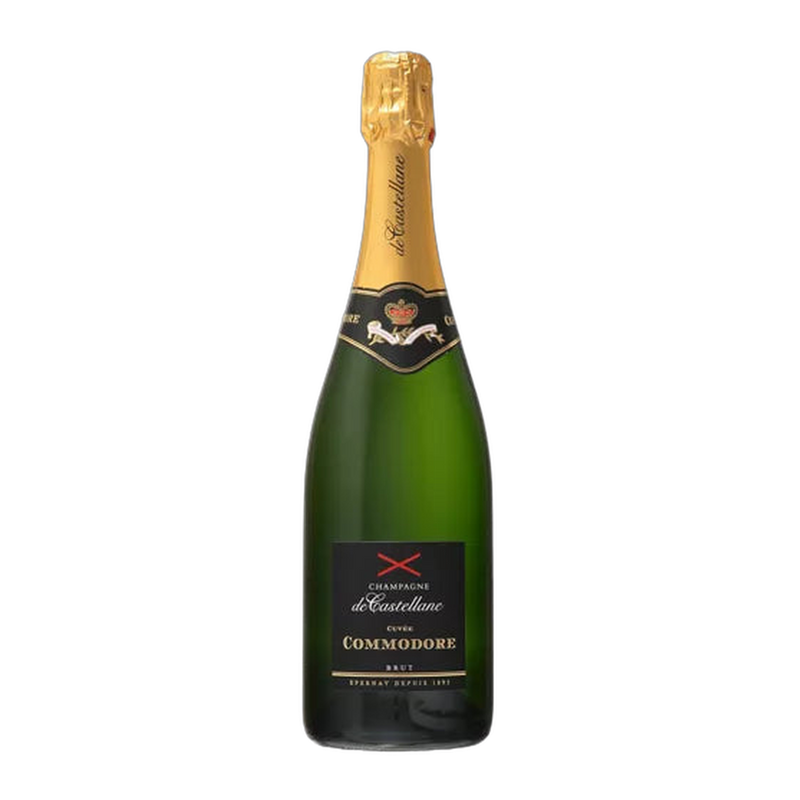
The Castellane Champagne Commodore
No reviews yet
This is the Prestige cuvee from Champagne de Castellane. Called the Commodore, this Champagne is made from grapes sourced from very old vines. The beautiful vineyards are decades old, and the thick trunks produce full, powerful bunches, which is what Castellane is proud of. And rightly so, because the rich history a...
Read more
Size
0.75L
Grapes
37,95
How this wine tastes
Explore the flavour profile, food pairings and tips for serving and cellaring.
Flavour profile
Body
Sweetness
Acidity
- Complexity
- Complex & deep
Aromas & flavours
Grape & vineyard
Winemaking & ageing
From vineyard to bottle
The origin, grapes and craftsmanship behind this wine.
This is the Prestige cuvee from Champagne de Castellane. Called the Commodore, this Champagne is made from grapes sourced from very old vines. The beautiful vineyards are decades old, and the thick trunks produce full, powerful bunches, which is what Castellane is proud of. And rightly so, because the rich history and expertise of this Champagne house are clearly evident. The winemaker and his team have delivered a masterful piece of craftsmanship with this Commodore.
The Castellane family is one of the oldest families in France, dating back to the tenth century. The Champagne house was established in Épernay in 1895. The house's striking logo features a red St. Andrew's herb, created by Vicomte Flores de Castellane. This was a clever marketing move, as St. Andrew was a patron saint, a figure that was especially celebrated at the time. This Champagne house boasts cellars spanning nine kilometers and a tower that symbolizes Épernay.
This Commodore is made from a blend of 45 percent Chardonnay, 30 percent Pinot Noir, and 25 percent Pinot Meunier. The grapes undergo two fermentations and a bottle-aging process in the cellars. After the primary fermentation, the wine still retains some bubbles and is bottled along with yeast cells and sugar. This initiates the secondary fermentation, which lasts approximately three weeks. The sugars are then converted into alcohol and carbon dioxide. Even after this fermentation, the yeast cells continue to function, called autolysis, where the dead yeast cells come into contact with the champagne. This process gives the champagne an aroma of fresh bread. Finally, the champagne is aged in the bottle for 24 months, which gives it its refined mousse (bubbles) and rich flavor nuances. The aroma reveals notes of white fruit, almond, brioche, and a hint of minerality. On the palate, this Champagne is fuller and thicker than regular Castellane, with beautiful, full flavors and a rich aroma. We think this Champagne is truly exceptional! Especially for its price.
Herkomst & details
The wine’s characteristics, origin and practical details.
The wine
Champagne · Chardonnay, Pinot Noir, Meunier
- Wine type
- Champagne
- Wine category
- Champagne
- Varietal(s)
- Chardonnay , Pinot Noir , Meunier
- Vintage
- -
- Size
- 0.75 L
- Alcohol content
- 12.0%
- Closure
- -
Origin & winery
France · Champagne
- Producer
- Champagne De Castellane
- Winery websiteWebsite
- www.castellane.com (opens in a new tab)
- Country
-
France
- Region
- Champagne
- Area
- Epernay
- Appellation
- Epernay
Origin: Champagne
Loading map…
The map is temporarily unavailable. Origin details remain above.
Terroir & maturation
-
- Soil
- -
- Maturation
- -
- Oak aged
- -
- Single grape variety
- -
- Sparkling
- Yes
- Malolactic conversion
- Yes
- Taste style
- Champagne
Serving & cellaring
Oysters,
Fried food,
Caviar,
Mild cheeses
- Ideal serving temperature
- 8° - 10°C
- Drinking Window
- 2024–2031
- Food Pairing
- Oysters,
Fried food,
Caviar,
Mild cheeses
More wines in this style
Discover wines with a similar flavour profile.
-
Gosset Champagne
Gosset Grande Reserve Brut Champagne
-
Gosset Champagne
Gosset Grande Rose
-
Gosset Champagne
Gosset Grand Blanc de Blancs
-
Champagne De Castellane
The Castellane Champagne Rosé
Recently viewed
Reviews from wine lovers
Read experiences with The Castellane Champagne Commodore or write your own review.
